Author Topic: On this Day (WWI aviation news), Vol. 3  (Read 59588 times)

Offline PJ Fisher

  • Hero Member
  • *****
  • Posts: 1434
    • Aero Rarities
Re: On this Day (WWI aviation news), Vol. 3
« Reply #180 on: September 21, 2024, 10:17:07 PM »
Danger Without Thrills
"Balloon Busting' is commonly recalled in history books as dangerous business.  Airmen braved dense ground fire to attack these well-defended observation stations. Today's article empathizes with the largely unsung observers who risked their lives as targets by climbing into the air in these highly flammable hydrogen-filled 'gasbags'.  The last paragraph succinctly describes the balloonists' ratio of risk and reward in contrast to aviators.  The image below shows one such balloon ironically rising above a makeshift cemetery.
(from the Observer & Pensacola Journal, 21 September 1918):


(image via sos.oregon.gov)
« Last Edit: September 21, 2024, 10:29:52 PM by PJ Fisher »

Offline PJ Fisher

  • Hero Member
  • *****
  • Posts: 1434
    • Aero Rarities
Re: On this Day (WWI aviation news), Vol. 3
« Reply #181 on: September 22, 2024, 10:41:26 PM »
Great Russian Raid
"The German seaplane base on Lake Angern posed a threat not only to the aviation presence on Runo Island but also to the passage of Russian naval vessels in the gulf.... On September 4, 1916 (N.S.), four Il’ia Muromets aircraft left the Zegevol’d Aerodrome near Pskov under the command of Lieutenant Georgii I. Lavrov. The detachment flew to Lake Angern and dropped seventy-three bombs on the German station, which housed seventeen seaplanes. Observers on the Russian aircraft confirmed the destruction and fires that consumed aircraft, hangars, and various structures. Multiple machine guns on the four reconnaissance-bombers suppressed enemy antiaircraft fire from the ground. As the Russians headed back to their aerodrome, they noted that columns of smoke were rising where the German seaplane station had been. The four large planes suffered no damage and returned safely from their mission to Zegevol’d." (via weaponsandwarfare.com)
(from the Carmarthen Journal, 22 September 1916):


(image: via imperialairpowerrussia.blogspot.com)

Here's a sketch rendering of an Oranosvsky-type bomb that would have equipped the Ilya Murmomets, which I've been tinkering with. Colors are speculative.

« Last Edit: September 22, 2024, 11:24:25 PM by PJ Fisher »

Offline PJ Fisher

  • Hero Member
  • *****
  • Posts: 1434
    • Aero Rarities
Re: On this Day (WWI aviation news), Vol. 3
« Reply #182 on: September 23, 2024, 11:48:01 PM »
Hand-Picked Men
The United States joined the Great War in April 1917, with the first soldiers having arrived in France just three months before today's publication.  The first air unit to arrive was the 1st Aero Squadron, commanded by recently promoted Lieutenant Colonel Ralph Royce, on September 1917.  This unit remains in operation today as the USAF 1st Reconnaissance Squadron.
(from Popular Science, September 1917).


(image: Royce, at left, standing aside Benjamin Foulois (who headlined here last September: https://forum.ww1aircraftmodels.com/index.php?topic=13750.msg258788#msg258788), 1918; via wikipedia)

« Last Edit: September 24, 2024, 04:13:20 AM by PJ Fisher »

Offline PJ Fisher

  • Hero Member
  • *****
  • Posts: 1434
    • Aero Rarities
Re: On this Day (WWI aviation news), Vol. 3
« Reply #183 on: September 25, 2024, 12:50:01 AM »
Kampflugzeuge
I'm always searching for articles representing every nation from the Great War. Here's a survey of aerial warfare from a German-American perspective, though it's a bit difficult to read.  One of the images depicts the British 10lb. Hale's bomb; which was pretty much obsolete by the time of this publication.
(from the Deutsche Correspondent, 24 September 1916):


Here's a group of 10lb. Hale's that I designed and printed in 1/32 scale.  Haven't quite finished painting them.

« Last Edit: October 01, 2024, 08:14:52 AM by PJ Fisher »

Offline PJ Fisher

  • Hero Member
  • *****
  • Posts: 1434
    • Aero Rarities
Re: On this Day (WWI aviation news), Vol. 3
« Reply #184 on: September 26, 2024, 07:13:11 AM »
Mechanics of War
These Austrians are at alert with this aircraft-detection system.
(from the Sydney Mail, 25 September 1918):


(image: 'Headlights with hearing device for pilots', via x.com

Offline PJ Fisher

  • Hero Member
  • *****
  • Posts: 1434
    • Aero Rarities
Re: On this Day (WWI aviation news), Vol. 3
« Reply #185 on: September 28, 2024, 04:15:38 AM »
Aftermath of the Attack
Lots of aerial action in today's recollection of Britain's ambitious if not wholly successful raid on on Zeebrugge.

"The plan needed a rare combination of wind, tide and weather; to obtain surprise the monitors would need to be in position before dawn. Mist and low cloud would make artillery observation from an aircraft impossible and the wind would have to be blowing from a narrow range of bearings or the smoke screen would be carried over the ships and out to sea, exposing them to view from the shore. The bombardment force sailed for Zeebrugge three times but changes in the weather forced a return to England each time.  On 11 May, Bacon ordered another attempt for the next day...  The bombardment ships had taken position, the Motor Launches had formed a line, ready to generate the smokescreen and the escorts formed a square around the monitors. Five destroyers zigzagged around the flotilla as a screen against U-boats, the minesweepers began operating around the monitors and the covering force cruised in the distance, ready to intercept a German destroyer sortie.

Two Royal Naval Air Service (RNAS) artillery-observation aircraft from Dunkirk, which had taken off at 2:00 a.m., had to wait from 3:00 a.m. over Zeebrugge for almost two hours. The aircraft were met by seven Sopwith Pups from 4 (Naval) Squadron RNAS, which patrolled the coast from 5:45 a.m. as six Sopwith Triplanes of 10 (Naval) Squadron RNAS flew over the fleet. One of the artillery-observation aircraft had engine trouble and force-landed in the Netherlands; the other ran short of petrol. Firing from the monitors was opened just after 5:00 a.m. and at first fell short; many of the shells failed to explode, which left the aircraft unable to signal the fall of shot. The accuracy of the bombardment improved soon after; Marshal Soult hit the target with its twelfth shell and Erebus with its twenty-sixth. Terror was most hampered by the loss of one of the aircraft and by dud shells; only forty-five of the 250 shells fired were reported and the observation aircraft had to return because of fuel shortage at 5:30 a.m., leaving the last half-hour of the bombardment reliant on estimated corrections of aim. Two relieving aircraft also had engine trouble and failed to arrive.

In the first hour... German retaliation was limited to anti-aircraft fire and attempts to jam the wireless of the artillery-observation aircraft. When the Pups from 4 (Naval) Squadron arrived, twice their number of German Albatros fighters engaged them and some of the aircraft from over the fleet, which joined in the dogfight. The British claimed five German aircraft shot down and the fleet was able to complete the bombardment. A third patrol later shot down a German seaplane into Ostend harbour and lost one fighter. At 6:00 a.m. the ships weighed anchor, just as the Kaiser Wilhelm battery opened fire. Two seaplanes which attempted to approach the fleet were driven off by British fighter seaplanes, which escorted the fleet home. Bacon returned with the impression that the bombardment had succeeded but aerial photographs taken the following week revealed that about fifteen shells had landed within a few yards of the lock gates on the western side and four shells had fallen just as close on the eastern side. The basin north of the locks had been hit and some damage caused to the docks but Zeebrugge remained open to German destroyers and U-boats. The Admiralty concluded that had the monitors been ready to fire as soon as the observer in the artillery-observation aircraft signaled or if the shoot had been reported throughout, the lock gates would have been hit.
" (via wikipedia)
(from the Auckland Weekly News, 26 September 1918):


« Last Edit: September 30, 2024, 07:24:52 AM by PJ Fisher »

Offline PJ Fisher

  • Hero Member
  • *****
  • Posts: 1434
    • Aero Rarities
Re: On this Day (WWI aviation news), Vol. 3
« Reply #186 on: September 28, 2024, 12:20:22 PM »
Berlin Bounty
Lamenting the loss of fellow Americans aboard the Lusitania, one exasperated executive is offering a Liberty Bond bonus to the first U.S. airman to bomb Berlin.  I don't think this happened during the Great War, though the next generation of yankee flyers dished it out pretty generously.
(from the Bendigo Advertiser, 27 September 1917):


Just for the fun of it, today you can spin your turrets and shake your engines to Glenn Miller's less-remembered WWII masterpiece 'Pistol Packin' Mama', which swings the story of a bombing raid on Berling while riffing off a country-music composition by Al Dexter.  After an atmospheric orchestral interlude the action starts at around the 2-minute mark:  https://www.youtube.com/watch?v=AEZqOUcwC28

Offline PJ Fisher

  • Hero Member
  • *****
  • Posts: 1434
    • Aero Rarities
Re: On this Day (WWI aviation news), Vol. 3
« Reply #187 on: September 28, 2024, 10:03:16 PM »
Disastrous "Air Holes"
A letter home from an Australian Airmen stationed in Palestine reports on the recurring danger of vertical drafts, as evidenced in this fallen Royal Aircraft Factory B.E.2e.
(from the Adelaide Chronicle, 28 September 1918):


Offline PJ Fisher

  • Hero Member
  • *****
  • Posts: 1434
    • Aero Rarities
Re: On this Day (WWI aviation news), Vol. 3
« Reply #188 on: September 30, 2024, 06:51:21 AM »
Another Russian Raid
One Week after our last headline from the Eastern Front we have a report of another Russian strategic incursion against German targets.  Perhaps it is not as successful as this story suggests.  "In order to distract the Germans in the north from a planned Russian offensive, the EVK decided to put on a show of force by sponsoring a major air attack against the headquarters of a German reserve division near the town of Boruna, just below the Russian offensive. The attacking force comprised four Il’ia Muromets planes and sixteen Morane-Saulnier French fighters, built by the Russian Dukh Company. The planes took off separately on September 25, 1916 (N.S.). Unfortunately, both the plans and their execution failed. The fighters missed linking up with the bombers and three of the larger aircraft never reached the target. One of the three Il’ia Muromets planes encountered German fighters supplied with explosive ordnance. An intercepted radio message later revealed that the Germans had lost three of their planes in the air battle; however, enemy bullets exploded one of the Russian bombers’ fuel tanks. The plane crashed, killing the entire crew, including its commander, Lieutenant Dimitrii K. Makhsheiev. Only the IM Kievskii completed the mission in triumph; overall, the show of airpower miscarried miserably" (via weaponsandwarfare.com).

I believe this was the only Ilya Muromets bomber that Imperial Russia ever lost to enemy aircraft fire (this occurred on 12 September in the Julian calendar). More information on the Morane Parasol that was lost would be welcome.
(from the Evening Star, 29 September 1916)


(image via www.renderosity.com)

Offline PJ Fisher

  • Hero Member
  • *****
  • Posts: 1434
    • Aero Rarities
Re: On this Day (WWI aviation news), Vol. 3
« Reply #189 on: September 30, 2024, 10:05:43 PM »
Albatros Lasso?
In the spirit of Dirigible-Al's recent post on old magazines' far-fetched science schemes (https://forum.ww1aircraftmodels.com/index.php?topic=14624.0), here's a sure-fire stratagem to fight your aerial foes.
(from Electrical Experimenter, September 1918):

« Last Edit: September 30, 2024, 11:33:47 PM by PJ Fisher »

Offline PJ Fisher

  • Hero Member
  • *****
  • Posts: 1434
    • Aero Rarities
Re: On this Day (WWI aviation news), Vol. 3
« Reply #190 on: October 02, 2024, 04:10:01 AM »
Where Eagles Dare
Looks like this French Farman was the victor in this sad head-on collision.
(from the Evening Capital News, 1 October 1916):

« Last Edit: October 03, 2024, 08:39:10 AM by PJ Fisher »

Offline PJ Fisher

  • Hero Member
  • *****
  • Posts: 1434
    • Aero Rarities
Re: On this Day (WWI aviation news), Vol. 3
« Reply #191 on: October 03, 2024, 08:36:42 AM »
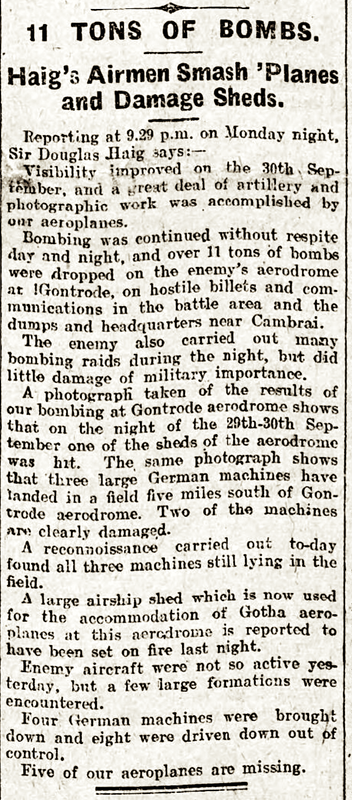
Gontrode Rush
Before the end of 1914 the Germans established Gontrode aerodrome in occupied Belgium.  Within a year it became an airship base kitted with a 180-meter-long hangar, nicknamed the 'Het Kot'.  Eventually Gontrode would be home to Kagohl 3 / Boghol 3 and Rfa 501 for harassing Britain with Gothas and Zeppelin-Staaken 'R' planes.  This made the aerodrome a natural target for enemy aircraft.  One early and well-remembered raid was conducted by Captain Lanoe Hawker, of No.6 Squadron RFC, in April 1915.  Today's news marks the beginning of the end of the airfield's practical use due to its increasing vulnerability.

"...beginning on 25 September Kagohl 3's aerodromes were attacked by the Allies nearly every day and night for over a week. The RFC concentrated on Gontrode dropping hundreds of darts in addition to high explosives, and on 29 September the old airship hangar was set on fire. Gontrode was raided the following evening while the Gothas were attacking England, although damaging hits were few. This steady Allied bombing forced the dispersal of the Kasten concentrated at Gontrode, and so Kasta 15 and Kasta 16 were moved to Mariakerke, causing Kasta 17 and Kasta 18 to relocate from Mariakerke to Oostakker. In addition, Stab Kagohl 3 moved from the Villa Drory, near Gontrode, to a large house owned by Countess Hemptin in Ghent itself. This left some of the R-planes of Rfa 501 still at Gontrode, where they remained until 7 March 1918, when the increased intensity of Allied raids obliged them to transfer to Scheldewindeke, which was equipped with a specially constructed concrete apron.  The Germans finally vacated Gontrode in October 1918, and after the ceasefire they destroyed most of what was left, including the large hangar. In 1920 the airfield was almost completely demolished leaving only two concrete shelters, which can still be found just west of the village of Gontrode." (via airhistory.org.uk)
(from the Cambria Daily Leader, 2 October 1917):
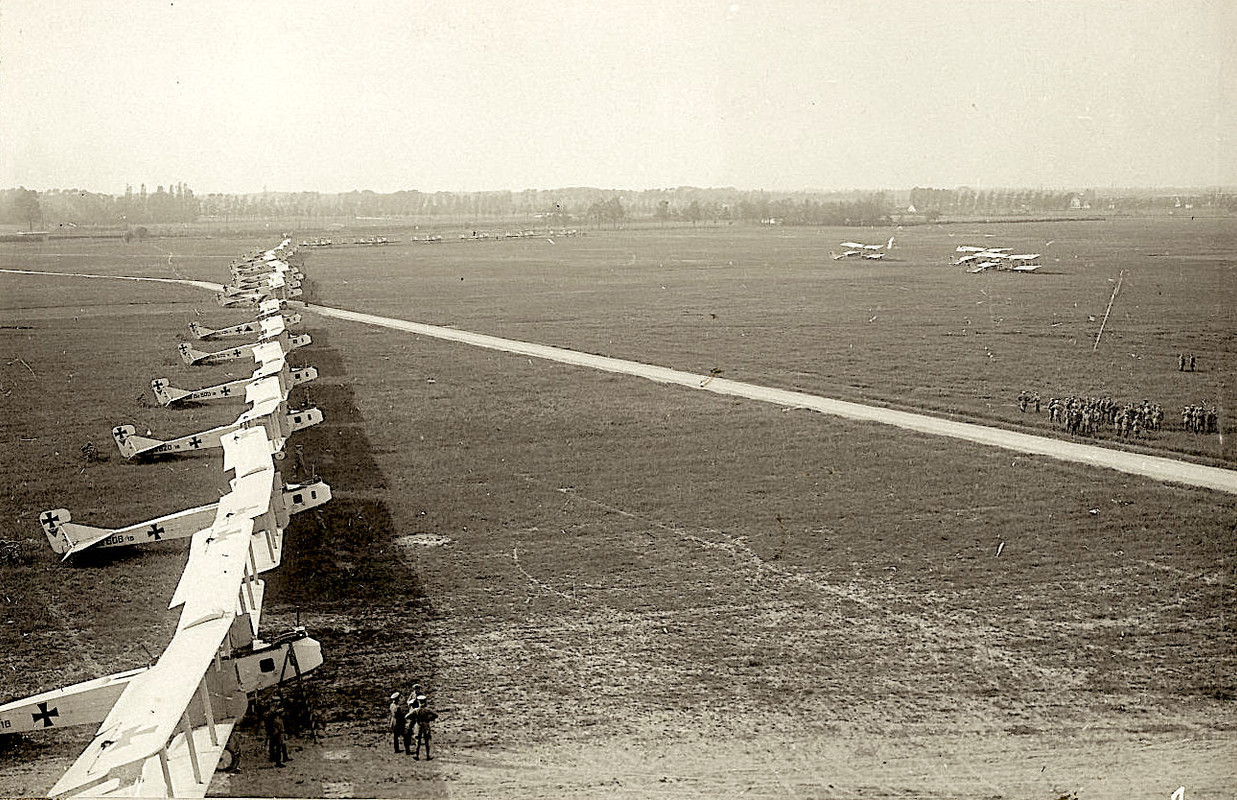
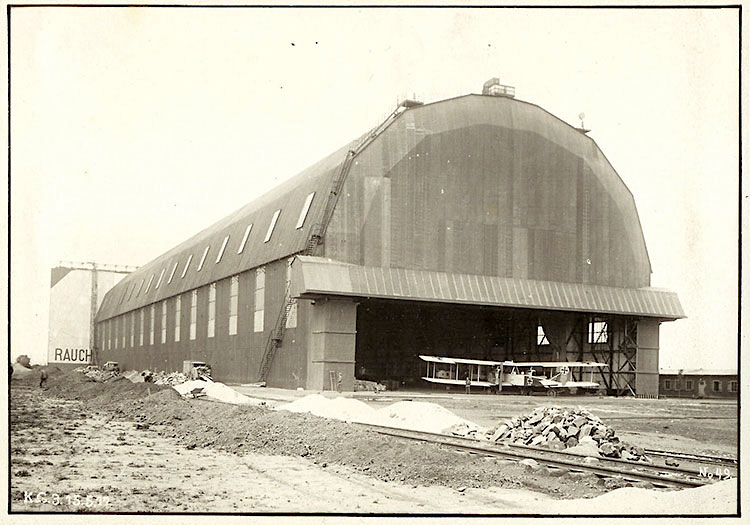
(images respectively via mentalfloss.com and hetvliegveldvangontrode.be)

« Last Edit: October 03, 2024, 11:43:17 AM by PJ Fisher »

Offline PJ Fisher

  • Hero Member
  • *****
  • Posts: 1434
    • Aero Rarities
Re: On this Day (WWI aviation news), Vol. 3
« Reply #192 on: October 03, 2024, 08:10:48 PM »
Star Struck
The familiar star-in-the-circle that emblazoned United States aircraft upon its entry into WWII was also its official insignia upon entering the Great War.  However, the original star would be stricken by February 1918. "To avoid confusion with German cross, and for commonality with Allied air forces during World War I, the US changed its roundel to the disused Russian design. Colors were to be based on US flag but availability resulted in considerable variation in hues" (via wikipedia).  The star would be reintroduced in 1919 and endured until being retired in May 1942.
(from the Sydney Mail, 3 October 1917):

« Last Edit: October 05, 2024, 12:57:07 AM by PJ Fisher »

Offline PJ Fisher

  • Hero Member
  • *****
  • Posts: 1434
    • Aero Rarities
Re: On this Day (WWI aviation news), Vol. 3
« Reply #193 on: October 05, 2024, 01:13:57 AM »
"Avion-Canon"
Despite it not making a significant impact in the war, the Aéronautique Militaire's Voisin IV, with its forward-firing Hotchkiss gun, must have looked fairly intimidating when it first appeared early in the war.   Some backstory:

"Captain Jean Faure... has been seconded to the Aeronautics service and assigned to the Military Aviation Laboratory. He is responsible for the manufacture of aviation projectiles (bombs, flechettes) and the development of launch devices. With the support of his superiors, he got in touch with the manufacturer Voisin so that it could install a 37 mm Hotchkiss cannon, weighing 100 kg, on its aircraft.   ...the tests of the first Voisin Canon began in May 1914 at Issy-les-Moulineaux, near the Voisin factories, with the pilot Rugère. The only safety measures consisted of the presence of two orderlies at each end of the field to "recommend passers-by to move away from the targets", and simple white canvas signs placed on the ground.

On November 5, 1914, a new test was scheduled with the engineer captain Rémy , pilot ( below ). The latter knew the terrain well, quite cramped, and knew that the weight of the cannon on the front of the plane had an impact on the flight characteristics. The tragedy occurred during takeoff, at full load, when the plane hit a hangar (or a house, testimonies differ), costing the lives of the two aviators.
" (via historim.fr)

(respectively from the Cambria Daily Leader and Scientific American; 4/7 October 1915):


(image via historim.fr)

Offline PJ Fisher

  • Hero Member
  • *****
  • Posts: 1434
    • Aero Rarities
Re: On this Day (WWI aviation news), Vol. 3
« Reply #194 on: October 06, 2024, 09:06:23 AM »
American Dreaming
Our recent headline reported that the Curtiss Aeroplane & Motor Company was caught up in the 1916 Triplane craze by adding a wing to their popular hydroplane design (https://forum.ww1aircraftmodels.com/index.php?topic=14363.msg269121#msg269121).  Here's a bombastic broadcast about another ambitious three-wing attempt to keep up with European designs.  This particular 'Zepp Chaser' could well have been one of Curtiss' 'S' series scouts.  Just looking at the impractical machine-gun setup, one could assume that, despite this article's claims, the concept was doomed to failure.  "In 1917, the S-3 became the first triplane in service in the United States. In 1918 and 1919, Curtiss experimented with seaplane versions of the S-3, designated S-4 and S-5. The S-6 was intended to be an improved S-3, but performance was poor and of the 12 ordered by the USASC, only 1 was delivered" (via wikipedia).  Shown here us the Model S-6.
(from the Grand Forks Herald, 5 October 1917):