the tubing was
probably Albion -- honestly not sure, I have tubing from several suppliers.
At any rate, I doubt the hardness of the brass is at issue-- carbide is much much much harder and will easily cut "half hard" brass which is the hardest temper you are likely to run across. In fact fully tempered brass is still much softer than carbide. If anything, being too soft is more of a problem as the bit might have a tendency to bind. But I digress

The exact tools I used will probably be of little use because you won't likely have the same stuff lying around. No matter. It's the principle that is important.
To do this successfully you need to think outside the box a little bit and construct a jig. If you are drilling by hand, you have to figure out a way to support the tool so that it can only move in the Z plane. Ron Kootje made this drilling jig for a similar task*:
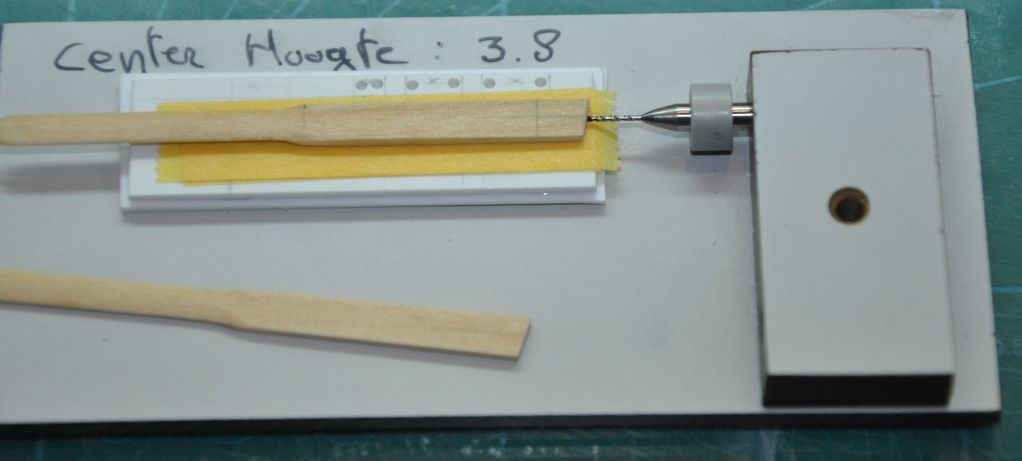
of course if you are fortunate enough to have a drill press or a small mill, your task is simplified and you only have to worry about accurately clamping the workpiece. Here are some hints:
1) cut the part to size
after the drilling operation. Duh? This way you will have ample meat to clamp or otherwise secure.
2) Consider gluing or taping the workpiece to the support instead of clamping.
3)
Bonus, Million Dollar Hint: CA dissolves in Acetone. Brass and wood don't.

You asked about the workflow, here it is:
1) cut off about 3" of tube to work with
2) smash end of tube with flat pliers
3) put tube into support jig (I happened to have made a support with lego blocks and some other stuff, would do it differently next time)
4) drill
5) trim end, shape with file & sandpaper, polish with steel wool
6) cut part from tube
7) repeat
----------------------------------------------------------------------
*By the way -- newcomers: this log is a must:
http://forum.ww1aircraftmodels.com/index.php?topic=533.msg8968#msg8968
